Ollie Robinson was ‘nowhere near ready for Ashes’ despite stunning comeback disp

The Dramatic Return of Ollie Robinson at Lord’s
The iconic Lord’s Cricket Ground has witnessed countless historic bowling spells, but few returns have carried as much emotional weight and tactical intrigue as Ollie Robinson’s sensational comeback. After a grueling two-and-a-half-year absence from the Test arena, the towering Sussex seamer marked his return with a virtuoso performance, dismantling New Zealand’s top order on a dramatic 16-wicket opening day. Armed with the new ball from the Nursery End, Robinson’s impeccable control and lethal wobble-seam deliveries instantly put England on the front foot.
Yet, despite the rapturous applause from the Lord’s faithful, Robinson remained incredibly grounded. Reflecting on his journey, he made a candid admission about his readiness during England’s previous struggles. Ollie Robinson was ‘nowhere near ready for Ashes’ despite stunning comeback disp at the Home of Cricket, acknowledging that he lacked both the mental maturity and physical conditioning required to endure the rigors of an intense Ashes campaign in Australia.
A Sensational Spell Destroys New Zealand’s Top Order
The dramatic nature of the first day’s play set the perfect stage for Robinson’s redemption. England’s batting lineup had faltered earlier in the day, collapsing to a meager 140 all out. With New Zealand seemingly holding the upper hand, England needed something extraordinary from their bowling unit. Robinson delivered precisely that. In his very first over, he produced a stunning triple-wicket maiden that tore the heart out of the Kiwi top order. He followed it up with a fourth wicket in an exceptional opening six-over spell, leaving the visitors reeling at 61 for 6 at stumps—still trailing England by 79 runs.
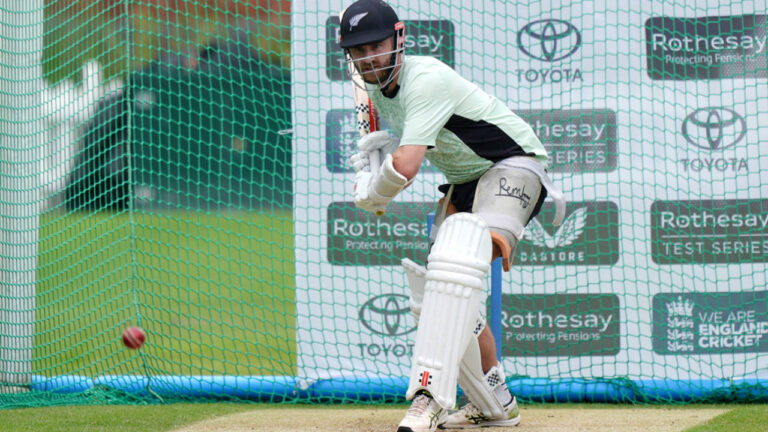
Among his scalps, none felt more significant than that of Kane Williamson. The New Zealand captain fell for a second-ball duck, looping an inside-edge to short leg. Robinson admitted that the roar from the Lord’s crowd following Williamson’s dismissal was unlike anything he had ever experienced. “There was a point where I couldn’t really hear the crowd,” Robinson reflected. “I was just on cloud nine, my legs were numb, and I was trying to calm myself down and focus on the moment. But after that second wicket, that’s probably the loudest I’ve ever heard on a cricket field. The crowd were amazing, and it was an unbelievably special day for me and the team.”
Mastering the Wobble Seam: A Tactical Breakdown
Robinson’s success was not merely a product of adrenaline; it was a masterclass in tactical adaptability. Watching New Zealand’s bowlers closely on the dressing-room television during the first innings, Robinson noted that traditional swing deliveries were not reacting off the pitch as quickly as those delivered with a wobble seam. After consulting with fellow paceman Gus Atkinson, Robinson decided to abandon his swing plans and pivot almost entirely to the wobble seam.
This acute bowling intelligence is what previously earned him the respect of veteran icons James Anderson and Stuart Broad. Robinson explained his thought process:
- Observation: New Zealand’s traditional swing balls were not reacting off the pitch as quickly as the wobble-seam deliveries.
- Execution: Robinson adjusted his release to focus almost entirely on wobbling the ball to extract maximum speed and movement off the surface.
- Communication: Partnering closely with teammate Gus Atkinson, Robinson formulated a specific strategy to swing the ball back to Tom Latham before getting him out.
“We saw that their swing balls weren’t really reacting off the pitch as quick as their wobble was,” Robinson explained. “All the batters came back and said it was nipping quite fast. I thought, as soon as I went out there, I would try and just wobble it. Me and Gus spoke about swinging it back to Tom Latham just before he got him out, but apart from that, it was mainly wobble.”
Honesty Regarding the Ashes and Mental Readiness
This impeccable display naturally raised questions about whether Robinson could have altered the course of England’s dismal 4-1 Ashes defeat in Australia. With his ability to extract steep bounce and subtle movement, he resembled the tireless Scott Boland, who troubled England so frequently during that series. However, when asked if he could have been England’s savior, Robinson sighed deeply. He admitted that during his winter stint in Australia—where he played grade cricket for Sydney University and bowled to Steve Smith in a New South Wales net session—he was simply not prepared for the big stage.
“To be honest, I was nowhere near ready to play, or anywhere near where I am now, as a person, as a cricketer,” Robinson confessed. “It’s only probably been the last few months that I’ve got the enjoyment back for the game and knuckled down a bit more.”
The Road Ahead Under Stokes and McCullum
Robinson’s resurrection has been heavily supported by England’s leadership team. Captain Ben Stokes and head coach Brendon McCullum have given him unwavering backing. In a symbolic gesture of his status, Robinson even switched his shirt number from 57 to 1—a number traditionally reserved for the captain. Robinson revealed that Stokes gladly accepted the request. “It’s my lucky number and my birthday,” Robinson smiled. “I didn’t realize it was the captain’s number, but Stokesy had no objections.”
However, the road ahead remains demanding. Stokes sent Robinson a direct text prior to the match, reminding him: “It’s great to have you back, but just know the hard work’s still to be done.” Robinson has taken those words to heart, acknowledging that his past struggles with fitness were the primary hurdle. “I don’t think I’m a different bowler,” Robinson added. “My skill has never really been in doubt. It’s more the fitness and other things. I know I have a lot of hard work to put in. I’m not the finished article, but sessions like today make it all worthwhile.”